
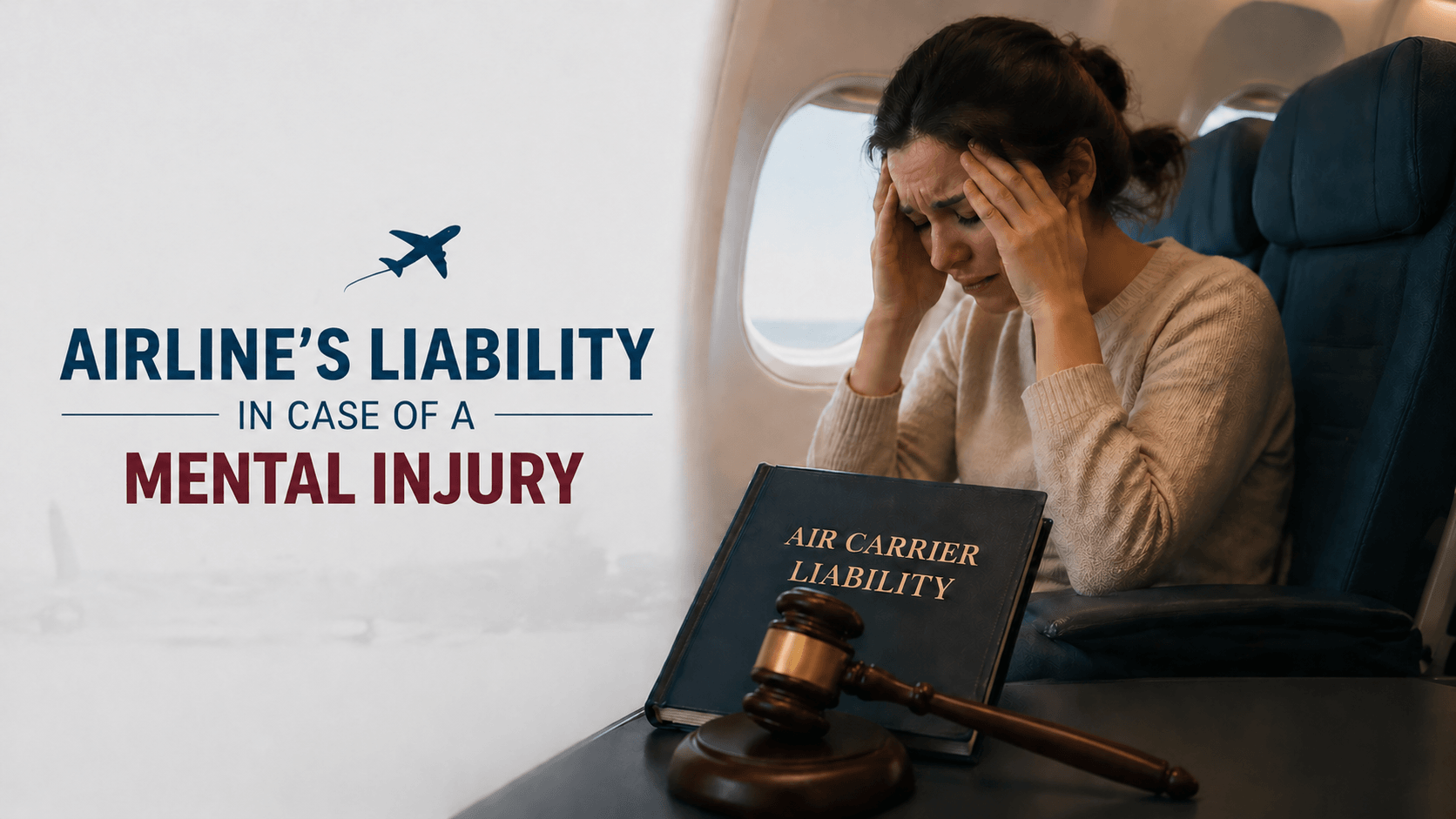
The area of airline’s liability in case of a mental injury is still not perfect. For instance in the case of Rothchild v. Tower Air, Inc. A person got pricked by a needle in the magazine pouch, the whole journey she was suffering from fear of getting infected with AIDS or Hepatitis but she was denied any compensation for the agony caused to her by the prick but she was only given compensation for her pain flowing from the needle prick. It is clear that mental agony caused to her by the prick was much greater than the pain caused by the prick but she was given compensation only for the injury which she actually suffered. In the present paper an analysis of the compensation in case of a mental injury is analysed and also its relevance in India.
The Carriage by Air Act, 1934 as amended in 2009 follows the Montreal convention on the issue of liability of Airlines in case of accident. But like its predecessor Montreal convention has also failed to address the two important lacunae of the former. In section 17 of the Montreal convention, the terms “accident” and “bodily injury” have not been clarified thus leading to huge litigation on this topic. Inclusion of the term mental injury in section 17 of the montreal convention was hugely debated but in the end the convention was just an English version of Warsaw convention as the Warsaw convention was officially only in French language.
For the purpose of easy understanding the views of courts, in allowing compensation in case of injuries, can be divided into following two parts: Before the Floyd case, and after the Floyd case.
Before Floyd case
Before the Floyd case, most of the lower courts in US were not uniform in interpreting the term bodily injury as some courts said that bodily injury encompasses mental injury while some held that mental injury must be accompanied by overt physical injury. As in the case of Hussarl v. Swiss Air Transport Co. The court allowed the compensation while it did not allow compensation in the case of Rosman v. Trans World Airlines although in both the cases the plaintiffs were in the same plane both suffered only mental injuries.
After Floyd case
In the case of Eastern Airlines, Inc. v. Floyd, a flight on its way to Bahamas from Miami but in the way all of its engine stopped working and this was informed to the people sitting in the flight. After this the altitude of the flight started to drop very fast but anyhow the pilots managed to restart one of its engines and all of them arrived safely.
In this case the Airline was sued for causing mental injury only. In this case the court analysed the English translation of the term lesion corporelle, which means bodily injury and not mental injury. Though some French courts have included mental injury within the ambit of the term bodily injury, the court held that cause of action arising solely on the basis of mental injury can not be allowed as when the court looked into the history of Warsaw convention, it was of view that Warsaw convention was basically made to protect air carriers and foster a new industry rather than giving the passengers full recovery. But the court left open the question of injury accompanied by the physical injury.
Later in the case of Ehrlich v. American Airlines, the court tried to narrow down the cleavage between mental injury and bodily injury. In this case the court has decided that airline can be held liable for the mental injury if that injury was caused by some bodily injury. For example if a person suffers a cut in the plane and gets traumatised by that then he will not be compensated for the trauma until and unless he proves that the trauma was because of the bodily injury.
Then in case of King v. Bristow Helicopters, Lord Mackay has opined that if it is proved that the brain of the plaintiff has suffered some injury and that the plaintiff fulfil other conditions of the convention then the damages to the plaintiff cannot be refused and this should come within the ambit of bodily injury as written in article 17 of the Montreal convention. In this case the tragic landing of the helicopter caused the plaintiff to develop Post Traumatic Stress Disorder and as a result of that the plaintiff suffered peptic ulcer among other mental injuries. In this case the plaintiff was given damages for the peptic ulcer.
And in the case of Weaver v. Delta Airlines Inc. The plaintiff was able to show that she suffered Post Traumatic Stress Disorder because of the emergency landing by the airplane and she was also able to prove that this disorder evidenced an injury to her brain and thus she was given damages.
Conclusion
Thus it can be concluded that the awarding of damages to the passengers in case of a mental injury is still a very debatable topic and in countries like USA and UK there have been sufficient case laws for redressal in case a passenger seeks relief but the case is quite different in India as we are not having significant case laws on this matter. So in order to give a proper framework to the issue of damages to passengers in case of injury some amendments in Carriage by Air Act, 1932 are required. So hereby it is suggested that the amendment should clearly include following injuries within the scope of the term “bodily injury” following should be included
- Physical injuries.
- Physical injuries leading to mental injuries.
- Mental injuries leading to physical injuries.
It is in no way advisable that in case of even only mental injuries some damages should be given otherwise the Airline companies will be facing zillion of cases as it is very hard to prove only mental injury and because of this many mischievous people will benefit from this.